Key insights and practical guidance from the Capital Area Startup Studio Workshop Series on how founders can use AI tools to build faster while avoiding technical pitfalls.
EAST LANSING, Mich.—(December 17, 2025)—Founders and early-stage builders gathered for this Capital Area Startup Studio workshop led by Jeff McWherter of Gravity Works Design and Development for an interactive session on how to leverage AI tools to build web applications faster without sacrificing long term control, quality, or scalability. Gravity Works Design helps its clients design and build digital products by combining user centered design, thoughtful engineering, and modern web technologies to turn ideas into usable scalable software.
What Is Vibe Coding?
You’ve probably heard of vibe coding, but do you know what it is? Vibe coding is building software by describing outcomes in plain language and letting AI generate much of the code. However, rather than replacing technical thinking, vibe coding shifts the founder’s role toward guiding, constraining, and evaluating what AI produces.

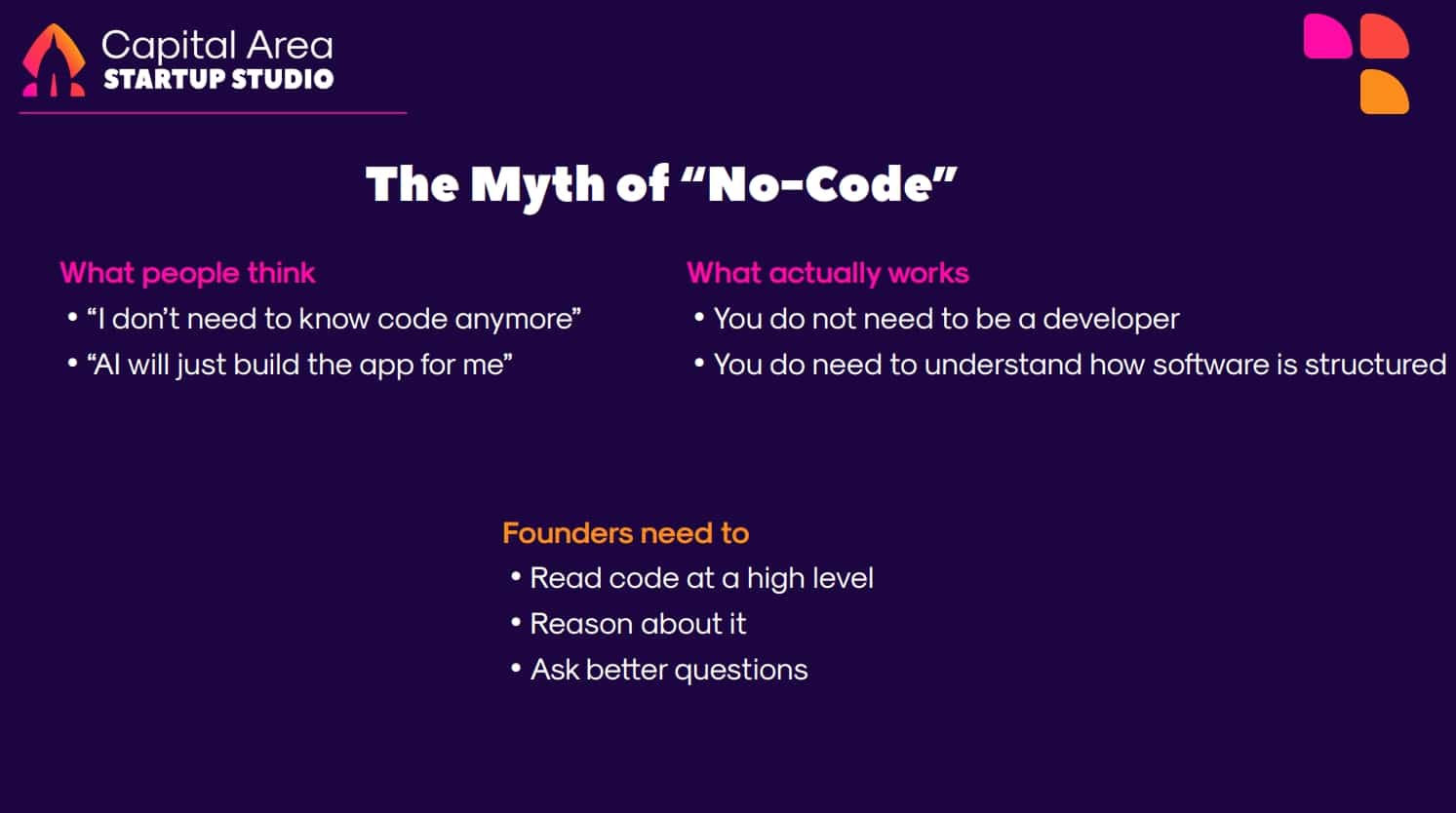
The Myth of No-Code
Low-code and no-code tools are often marketed as eliminating the need to understand software entirely, but in practice no-code is a little bit of a myth. Founders do not need to be developers to use AI tools to build software, but they do need basic code literacy to read, reason about, and ask better questions of their tools.
Using the Right AI Tools
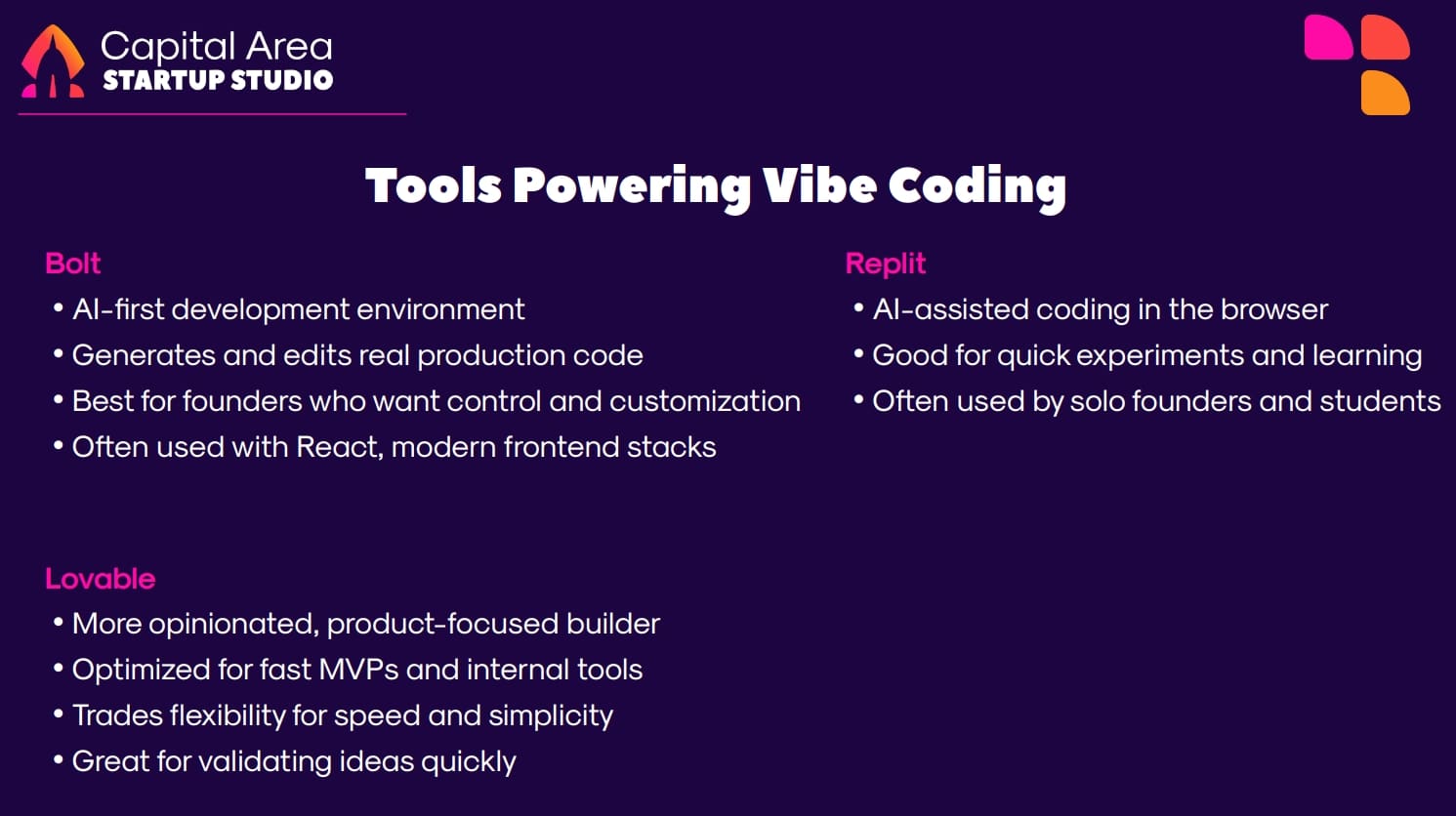
The session compared popular AI-powered development platforms like Bolt, Lovable, and Replit, highlighting their strengths, tradeoffs, and ideal use cases. Attendees learned what these tools do well, such as scaffolding apps, generating UI components, and writing boilerplate, and where human judgment remains essential, including architecture, security, and product decisions.
Prompting is a Technical Skill
A key theme throughout the session was that prompting is a technical skill. Strong prompts with clear scope, inputs, outputs, and constraints produce usable code, while vague, buzzword-driven requests lead to fragile results. Real-world examples illustrated how specificity dramatically improves outcomes.
A live demo showed how to use Bolt to build a form to collect data, from the front end collection form to the backend data storage.
Technical Literacy and Technical Debt
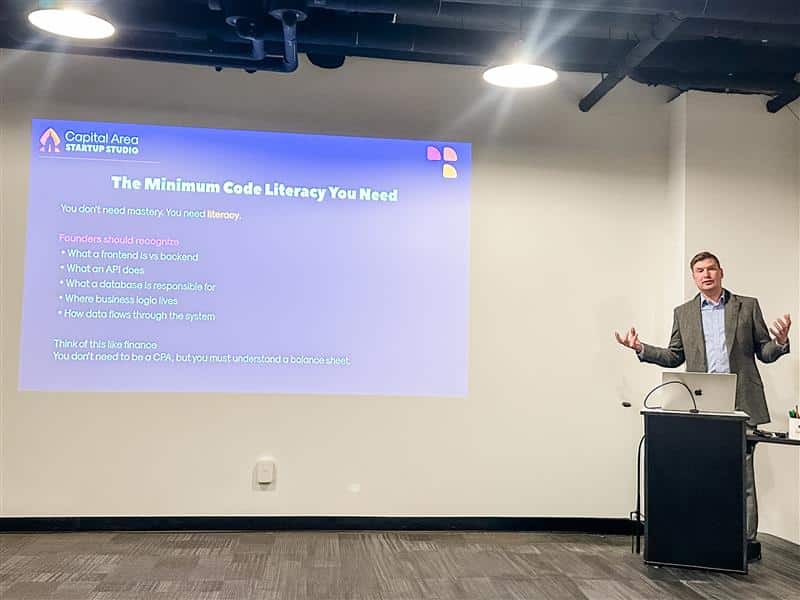
AI was framed not as a CTO or senior engineer, but as a fast-moving junior developer and powerful prototype accelerator. The discussion also covered core application structure, including frontend, backend, and database, and the minimum level of technical literacy founders need to avoid accumulating unnecessary technical debt.
Technical debt is the hidden cost of choosing quick or easy solutions in software instead of better long term ones. It happens when code is written to move fast now but creates problems later such as being hard to understand change or scale. Like financial debt it can help you move faster in the short term but it comes with interest. Over time it requires extra effort to fix bugs add features or onboard new developers.
With a strong foundation of technical literacy founders can use AI tools more effectively and create software with less technical debt. Additionally, technical debt is not always bad. Early stage teams often take it on intentionally to test ideas and get to market quickly. The problem arises when it is ignored or accumulated without a plan to clean it up.
Overall, the session reinforced a clear message: AI can dramatically accelerate product development, but founders who pair speed with understanding are the ones who truly stay in control.
The slides from this session are available here.
About the Capital Area Startup Studio
The Capital Area Startup Studio helps founders build tech enabled businesses that strengthen our regional innovation ecosystem. The program includes:
- An incubator for a select group of founders who have been accepted into the program and receive training, guidance, and hands on support.
- A series of public events covering topics from low-code / no-code training and AI enablement to essential business skills that help small companies enable tech within their businesses and accelerate growth.
More information on the Capital Area Startup Studio can be found here.
From seed to bloom, we grow together. We are grateful for the ecosystem partners who nurture this growth:
- This session was presented by Jeff McWherter of Gravity Works Design and Development, a web development agency that builds digital solutions to help good people accomplish great things.
- The Capital Area Startup Studio is led by Blake Grewal from Boost for ESOs and Jeff McWherter in partnership with Gravity Works Design and Development.
- The event took place in the SmartZone at the Technology Innovation Center, managed by the MSU Research Foundation and sponsored by the SmartZone.
- These events, programs, and efforts are powered by the Lansing Regional SmartZone, which supports high-tech and high-growth businesses in starting, growing, and thriving in our region.
If you believe these efforts matter, please share your support for continued SmartZone funding with your State legislators and local municipalities.
Check out the next Capital Area Startup Studio Event:
Legally Setting Your Business Up for Success
January 14 | 5:30 – 6:30pm | Free Registration
East Lansing Technology Innovation Center, 300 Room